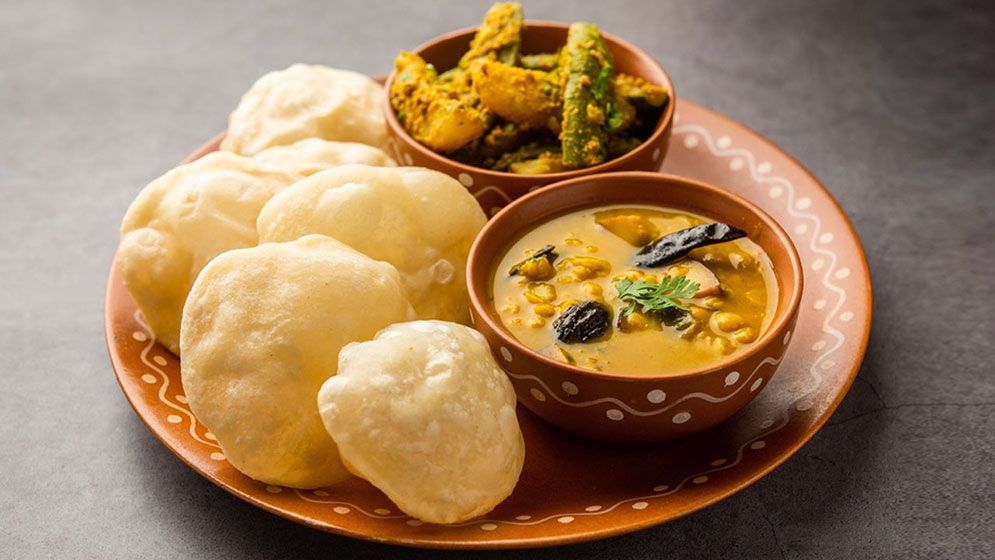
Luchi
Soft, puffed Bengali fried bread commonly served with vegetable preparations during festive meals.

Religious & cultural
Also known as Jagaddhatri Puja
A Bengali Hindu festival honouring Jagaddhatri, celebrated with worship, elaborate idols, lights and processions.
Jagaddhatri Puja is a Hindu festival devoted to Goddess Jagaddhatri, a form of the Divine Mother worshipped particularly in Bengal. Her name is commonly understood as referring to the one who sustains or upholds the world.
The festival is marked by temple and household worship as well as large public pujas. Chandannagar and Krishnanagar in West Bengal are especially associated with elaborate idols, decorative lighting, artistic pandals and processions.
Jagaddhatri as sustainer — Jagaddhatri is revered as a divine power that upholds and protects the world, giving the festival a strong theme of preservation and spiritual steadiness.
Mastery over the restless mind — Her lion standing over the elephant demon Karindrasura is traditionally interpreted as the overcoming of uncontrolled or destructive forces, including the restless mind.
Devotion to the Divine Mother — Worshippers offer prayers, flowers, incense, food and other ritual offerings while seeking divine protection, strength and well-being.
Jagaddhatri is described in Bengali religious and Tantric traditions in relation to Durga, and representations of the goddess are found in older temples of Bengal. The organised public festival became particularly prominent in Nadia and Hooghly during the eighteenth century.
Local traditions often associate the expansion of the annual puja in Krishnanagar with Maharaja Krishnachandra. Chandannagar developed its own distinctive tradition, shaped by Bengali devotional practice, local community organisation and the town's historical French-colonial setting. The precise beginnings of worship in the region are debated, and different family and local traditions preserve different accounts.


